I often wonder if students still need to learn basic number facts like multiplication tables. I'm told that they do, but I see so many that don't know basic multiplication facts.
Students, parents and even some of those affecting the direction of education seem to think that students don't need to "memorize" math facts. That's "old school" like when teachers used to hit students with pointers, (remember the wooden sticks with the rubber tips)?
Memorize multiplication tables? That's simply torture with no rationale or valuable outcome. You'd think it's Abu Ghraib or something! After all, we all have access to calculators pretty much all the time.
Pretty soon students probably won't need to write script/cursive. Oh wait...I think that already happened too. I guess being able to read script isn't important either.
Anyway, the analogy I use that seems to work for me is comparing knowing number facts to driving. Could you imagine if every time while you were driving and saw a sign you had to stop, interpret and then proceed? That analogy works if you assume that students eventually get their number facts correct after thinking about it (even though they often don't).
So I come to a red, eight sided sign that says "stop". Do I need to think about what to do? No. Am I even reading the sign? Maybe not.
I can drive from here to work and sometimes not remember anything about the whole ride. My brain helps me drive almost subconsciously.
When a ball rolls across the street, I automatically hit the breaks. No active interpretation needed. Ball = STOP! Street lights, merging into traffic, turning, whatever.
There was a time in my life that I needed to consciously decide what to do and how every moment through the process.
With mathematical facts, I just know them because I had to learn them. I think this is what many students are missing and why they stumble through math. They stop to think about every step in the process of solving mathematical problems. 6 X 7...uhhhhhhh. Damn! 36? uhhhhhhh. Ok 42.
Obviously these problems are may differ in different areas, schools,
etc.... but when I encounter a struggling student, I usually find that
the issue is with basic math.
If the simple processes could be truly mastered and internalized and become part of students thinking process, they would do much better.
I feel that the basic skills mastery is usually the difference between good students and bad ones.
-Multiplication tables
-Working with fractions
-Operations with integers
These are the root of many of my students' problems. I usually hold pop boot camps several times throughout the year, and I think I've been able to do some good.
I'd love to know how others feel about this and what if anything they do to combat this problem.
Added 8/9:
Chris Robinson has an interesting blog post about number sense here, check it out.
Wednesday, August 7, 2013
Monday, August 5, 2013
Parent Roadmaps for CCSS
While looking for some simplified explanations of the CCSS, I stumbled across the Council of the Great City Schools website.
For your convenience and mine, I have also placed links to these docs in the subject/topic specific pages I created here.
This organization has created PDF documents that can be shared with parents to help simplify the CCSS. Take a look...here are links to the 6th Grade through High School Math docs:


![]() |
| click |
There are also similar documents for the English CCSS.
![]() |
| click |
***The Parent Roadmaps to the Common Core State Standards may be reprinted or posted online for non-commercial purposes without the Council’s prior consent. Please include attribution to the Council of the Great City Schools.
Sunday, August 4, 2013
My Favorite: Remind 101 (text students and parents)
One of my "my favorites" at TMC13 was Remind 101 and using it to communicate with my students and their parents.
Remind 101 is a free service that allows teachers to set up lists they can send text messages to. The important thing is that users do not know each others' phone numbers.
You can even publish your messages to your website or blog by inserting some HTML code. Go to the "My Widgets" screen to access the code you'll need to insert.
The text you'll need to insert can be seen in this image. There is even a preview of what it will look like on your site. (I covered my token number which is unique to my account)
Here is a quick sample of how you might use on your own website:
Notice I also added a feed from my class blog into the right column. These widgets will allow one stop shopping for all of my communications.
Please feel free to contact me if you would like more more info or help setting your up.
Twitter: @aanthonya
- I set up a class called "TMC13" and invited all participants to join the group.
- I sent out the instructions via Twitter explaining how to be added to the list.
![]() |
| click to enlarge instructions |
- The image is generated by the system and is easy to share with students and parents. Once they follow the instructions, they are added to the list for their class and will receive texts on their phone.
- To send messages, I used the dashboard to select the correct class "TMC13", type in the message and send.
![]() |
| My dashboard as i looked at TMC13 |
You can even publish your messages to your website or blog by inserting some HTML code. Go to the "My Widgets" screen to access the code you'll need to insert.
The text you'll need to insert can be seen in this image. There is even a preview of what it will look like on your site. (I covered my token number which is unique to my account)
Here is a quick sample of how you might use on your own website:
Notice I also added a feed from my class blog into the right column. These widgets will allow one stop shopping for all of my communications.
Please feel free to contact me if you would like more more info or help setting your up.
Twitter: @aanthonya
Saturday, August 3, 2013
TMC13
So it's been almost a week since TMC13 ended. It comes and goes so quickly, but it's impact will stay with me for a long while. While writing this I wanted to mention that although I loved TMC13, it was just missing something for me since @fouss and @druinok were not there.
Even though my grey hair tells you I've been teaching for a hundred years, the fact is I am only entering year four. In fact, I was probably one of the oldest people at TMC13, but have less experience than most people there. My experience is mainly in the non-teaching world. This experience serves me well in general, but I will always feel that I have a lot to learn.
Even though in my business career I was responsible for tens of millions of dollars and managed dozens of people, there will always be twinge of inadequacy in me when I am in a teaching environment.
Teaching makes me feel younger than I am because of the nature of what it takes to be a teacher and that I am mostly around younger people. After 15+ years in the stuffy marketing/advertising world, I am more energized for life in general now more than ever. One of my favorite parts of teaching is that I get to re-boot each year. In my previous career, any frustrations I had tended to fester and build. Maybe this is why in that industry people generally turn over and switch companies or roles frequently.
As a teacher, we can work hard in year x, succeed some and fail some, but in x+1 start over with some extra knowledge we didn't have before. This for me is heaven. I get to keep trying to fix what I know is wrong. It's like using a pencil with eraser in your career.
Anyway, one thing that has stayed consistent for me is my tweeps. My first two tweeps that I tweeted with frequently were@fouss and @jreulbach. The people that had been helping me survive from a distance are always there for me (and I for them) year after year. That list has grown in a big way.
Last year when the prospect of a Math Teacher cruise cropped up, I was excited! To be honest, I felt much better when the cruise idea died and the idea for math camp in St. Louis took priority. In fact I even remember@fouss and others trying to see who was interested.
I really felt a connection with those peeps. To be honest, I don't think I could have made it through my first couple of years without them. Even if I didn't actually know them or even follow them, there was something about what we shared that swept me up. Bottom line, that crew@fouss, @jreulbach, @druinok, @lmhenry9 and the rest of TMC12 swept me off my professional feet.
TMC13 was equally awesome personally and professionally although I think the vibe was slightly different. I suppose there will be growing pains for "la cosine nostra". I use that term as a joke. I kind of feel like I am part of the Math teacher mafia now, La Cosine Nostra! Growing up on Staten Island and now living in New Jersey, both homes to "La Cosa Nostra", translated "this thing of ours"....the mafia.
Statistics in the Morning
Although I am mainly an Algebra 1 teacher, I wanted to spend my morning sessions with the stats group. I am much less comfortable teaching stats than algebra so was in desperate need of arms to fall into. I'm pretty sure @approx_normal could catch me if I fell. Hedge, your stats presentation was my single favorite session of the whole event!
@maxmathforum you simply rock! Your session will remain one of my favorites. You are a good person and a great thinker and teacher. Thank you for "notice" and "wonder"! Now I do more than ever before. Also it was wonderful that your colleagues from Drexel helped us get around. The facility was amazing and the people were wonderful. Please tell those folks thanks again (and good luck to the undergrads).
@gwaddellnvhs (Glenn), you are a great roommate and great mentor. Your knowledge of statistics is mindblowing!
-I need a break here. I can't believe I even rambled this much! I still have a lot more to write. Wanted to post this for now...will add more later. :-)
Even though my grey hair tells you I've been teaching for a hundred years, the fact is I am only entering year four. In fact, I was probably one of the oldest people at TMC13, but have less experience than most people there. My experience is mainly in the non-teaching world. This experience serves me well in general, but I will always feel that I have a lot to learn.Even though in my business career I was responsible for tens of millions of dollars and managed dozens of people, there will always be twinge of inadequacy in me when I am in a teaching environment.
Teaching makes me feel younger than I am because of the nature of what it takes to be a teacher and that I am mostly around younger people. After 15+ years in the stuffy marketing/advertising world, I am more energized for life in general now more than ever. One of my favorite parts of teaching is that I get to re-boot each year. In my previous career, any frustrations I had tended to fester and build. Maybe this is why in that industry people generally turn over and switch companies or roles frequently.
As a teacher, we can work hard in year x, succeed some and fail some, but in x+1 start over with some extra knowledge we didn't have before. This for me is heaven. I get to keep trying to fix what I know is wrong. It's like using a pencil with eraser in your career.
Anyway, one thing that has stayed consistent for me is my tweeps. My first two tweeps that I tweeted with frequently were
Last year when the prospect of a Math Teacher cruise cropped up, I was excited! To be honest, I felt much better when the cruise idea died and the idea for math camp in St. Louis took priority. In fact I even remember
I really felt a connection with those peeps. To be honest, I don't think I could have made it through my first couple of years without them. Even if I didn't actually know them or even follow them, there was something about what we shared that swept me up. Bottom line, that crew
TMC13 was equally awesome personally and professionally although I think the vibe was slightly different. I suppose there will be growing pains for "la cosine nostra". I use that term as a joke. I kind of feel like I am part of the Math teacher mafia now, La Cosine Nostra! Growing up on Staten Island and now living in New Jersey, both homes to "La Cosa Nostra", translated "this thing of ours"....the mafia.
Statistics in the Morning
Although I am mainly an Algebra 1 teacher, I wanted to spend my morning sessions with the stats group. I am much less comfortable teaching stats than algebra so was in desperate need of arms to fall into. I'm pretty sure @approx_normal could catch me if I fell. Hedge, your stats presentation was my single favorite session of the whole event!
@maxmathforum you simply rock! Your session will remain one of my favorites. You are a good person and a great thinker and teacher. Thank you for "notice" and "wonder"! Now I do more than ever before. Also it was wonderful that your colleagues from Drexel helped us get around. The facility was amazing and the people were wonderful. Please tell those folks thanks again (and good luck to the undergrads).
@gwaddellnvhs (Glenn), you are a great roommate and great mentor. Your knowledge of statistics is mindblowing!
-I need a break here. I can't believe I even rambled this much! I still have a lot more to write. Wanted to post this for now...will add more later. :-)
Friday, April 26, 2013
Zero Factor Property in Assessment of Teachers
A little bit of a venting session here...
(good teacher) (good lesson planning) (x) (y) (z) (aa) (ab) ....... (student effort = zero) = 0
In other words, a student can have the best teacher in the world...the best teacher that has ever lived...the Babe Ruth of teachers...the Beatles of teachers...but if they don't do their part, they won't learn anything. Learning requires effort on the part of the learner.
As we all move into formal assessment of teacher effectiveness, I can't help but wonder about a lot of things.
Politicians and bureaucrats have put together assessment requirements which consider factors that contribute to teacher effectiveness. But to my math teacher mind, we must have all of the factors to get the "right" answer. That of course depends on which question you're trying to answer.
How should a teacher be evaluated if one of those factors out of his/her control is zero? or very small? Isn't the student a factor in their own performance?
I have not seen much reference to student factors in teacher effectiveness, (Does the student want to learn?) and (Does the student do the things required)?
A further factorization of student factors gives us...
(does he attend class) (does she pay attention/take notes) (does he study) (x) (y).... (z)
.........But these are not used to evaluate our teachers or our educational system. Almost all of the weight is placed on the teacher. The teacher factor is important, but if student effort is zero, the result will be zero, right?
I am all for evaluation of teachers, but I am not for unfair assessment. Teacher quality is surely one of the most important factors in learning, but becomes irrelevant if factored with zero or a fraction.
Why don't any of the assessments I've seen consider what the student is doing to learn?
I see video examples of great teaching all the time. These videos typically show a scene in a charter school with students wearing uniforms, 100% engaged and aggressively TRYING to learn.
In my teaching I work very hard at making it easier for students to want to be engaged. In a sense, I am a performer on stage, I make lessons interesting, fun, relevant, organized, and all of the other things. I believe that I am a good teacher who continues to try to improve. I'm not perfect, but I am working towards it.
But the fact is, many students just don't care and let's face it....some students work hard to NOT learn.
I would like to see this student factor in the equation.
(good teacher) (good lesson planning) (x) (y) (z) (aa) (ab) ....... (student factor = zero) = 0
Don't even get me started on students who add a negative factor to the equation!
(good teacher) (good lesson planning) (x) (y) (z) (aa) (ab) ....... (student effort = zero) = 0
In other words, a student can have the best teacher in the world...the best teacher that has ever lived...the Babe Ruth of teachers...the Beatles of teachers...but if they don't do their part, they won't learn anything. Learning requires effort on the part of the learner.
As we all move into formal assessment of teacher effectiveness, I can't help but wonder about a lot of things.
Politicians and bureaucrats have put together assessment requirements which consider factors that contribute to teacher effectiveness. But to my math teacher mind, we must have all of the factors to get the "right" answer. That of course depends on which question you're trying to answer.
How should a teacher be evaluated if one of those factors out of his/her control is zero? or very small? Isn't the student a factor in their own performance?
I have not seen much reference to student factors in teacher effectiveness, (Does the student want to learn?) and (Does the student do the things required)?
A further factorization of student factors gives us...
(does he attend class) (does she pay attention/take notes) (does he study) (x) (y).... (z)
.........But these are not used to evaluate our teachers or our educational system. Almost all of the weight is placed on the teacher. The teacher factor is important, but if student effort is zero, the result will be zero, right?
I am all for evaluation of teachers, but I am not for unfair assessment. Teacher quality is surely one of the most important factors in learning, but becomes irrelevant if factored with zero or a fraction.
Why don't any of the assessments I've seen consider what the student is doing to learn?
I see video examples of great teaching all the time. These videos typically show a scene in a charter school with students wearing uniforms, 100% engaged and aggressively TRYING to learn.
In my teaching I work very hard at making it easier for students to want to be engaged. In a sense, I am a performer on stage, I make lessons interesting, fun, relevant, organized, and all of the other things. I believe that I am a good teacher who continues to try to improve. I'm not perfect, but I am working towards it.
But the fact is, many students just don't care and let's face it....some students work hard to NOT learn.
I would like to see this student factor in the equation.
(good teacher) (good lesson planning) (x) (y) (z) (aa) (ab) ....... (student factor = zero) = 0
Don't even get me started on students who add a negative factor to the equation!
Sunday, December 30, 2012
Common Core, Common Shmore
I Need to Sort This Common Core Stuff Out!
I am still fumbling around the Common Core Standards in my planning. In particular, what exactly do they mean? Where do i fall short? Where do the students fall short when they come in to my class?
The PDF document that is provided is not very user friendly in my opinion. I'm more of an Excel guy. I like to search, sort, filter, report etc....
I did a search to see if anyone had already done the hard work of getting this mess into an Excel document. Even though I teach in New Jersey, I looked at the Illinois BOE site and found a pdf with almost exactly what I was searching for.
Using that PDF, I was able to copy and paste into MS Excel and then add some fields with additional descriptions and sort fields and end up with a much more usable document (in my opinion).
If you like Excel and use the Mathematics common Core Standards, you might like this.
Common Core Standards (MS EXCEL)
Please share any input you might have to make this better, and feel free to link back to any docs or edits you make. :-)
How do I plan on using this? Well...
Glenn also has another version of a similar spreadsheet. Worth checking out!
I am still fumbling around the Common Core Standards in my planning. In particular, what exactly do they mean? Where do i fall short? Where do the students fall short when they come in to my class?
The PDF document that is provided is not very user friendly in my opinion. I'm more of an Excel guy. I like to search, sort, filter, report etc....
I did a search to see if anyone had already done the hard work of getting this mess into an Excel document. Even though I teach in New Jersey, I looked at the Illinois BOE site and found a pdf with almost exactly what I was searching for.
Using that PDF, I was able to copy and paste into MS Excel and then add some fields with additional descriptions and sort fields and end up with a much more usable document (in my opinion).
If you like Excel and use the Mathematics common Core Standards, you might like this.
Common Core Standards (MS EXCEL)
Please share any input you might have to make this better, and feel free to link back to any docs or edits you make. :-)
How do I plan on using this? Well...
- I will be adding fields that specify when I cover each of the standards I am responsible for
- Add field to specify which HS course (Alg1, Alg2, Geom, Precalc, etc...) is responsible for each standard for better planning.
- Determine which standards students fall short in when they enter my class and leave my class.
- Note which previously "mastered" standards might need some additional focus. Share that info with other teachers for their planning.
- Field feedback from other teachers about which standards students fall short in for better planning.
Glenn also has another version of a similar spreadsheet. Worth checking out!
Saturday, September 22, 2012
Statistics: Murder in the United States (Wall Street Journal)
This looks like a great set of data to use with my Statistics class. very interactive, very real and is sure to open up class for some real discussion about what statistics mean.
Check out this interactive page at Wall Street Journal. You can view, filter and display stats in various ways. Click the image to launch the page. Goof around with it. What kind of interesting things can you find about these statistics?
![]() | |||
| Click to launch page |
Sunday, September 16, 2012
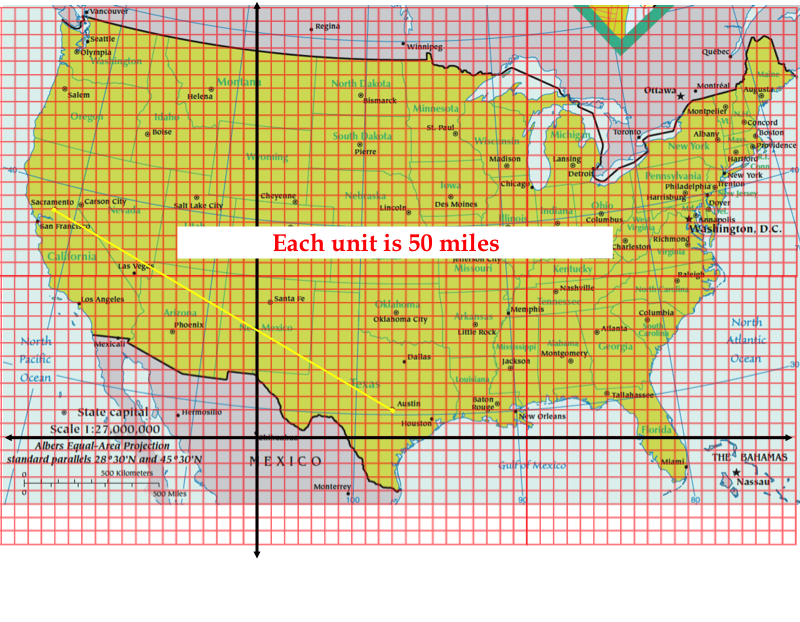
How far is Sacramento from Austin?
LINKS:
Link to SmartBoard Notebook file
Link to PDF
Link to this in the INB content repository I added to msmathwiki
This week I move into Distance and Midpoint formulas and wanted to have better examples than the ones in the book. I made a SmartBoard Notebook file that helps me walk through using the formulas step by step by trying to find the distance between the two cities. This isn't much different than the book examples except for the fact that using technology we build to the conclusion step by step.
Where are the cities on the map? (you're welcome Social Studies teachers)
How do I plot points on a map?

What does the scale mean? How do I use it? How else could I find the distance between these cities?
Use the grid to plot the points then remove the grid because we really don't need it anymore. I talk about how I can put the whole map in the first quadrant to make all of the values positive if I wanted to. In fact, I can put it anywhere. The important fact is the relationship is the relationship between the two points. I could move the grid and do a second example if needed.
We work through the example by plugging in the x and y values to get an approximate distance of 1,458 miles.

I also have large wall maps that are dry erase so will have the students work in groups to work out other distances and midpoints. I really got those just to add color to that wall, but hey, a little geography in math class never hurt anyone! (I have little globes too, from my pre-calc class two tears ago)
You can see my group sized white boards in the lower center of this picture. They are in their home made white board stand I made out of PVC pipe. I have 12 boards there!
If you look in the back near the window, you can see the individual sized white boards in their stand.
Sunday, August 26, 2012
Interactive Notebook Content Repository Wiki
What?:
I made a place dedicated to Interactive Notebook Content. Stuff that we can all use and share. A place where we can upload pictures, links, files etc... to one place that is organized by subject and topic. Please visit the wiki, borrow stuff, share stuff and PLEASE give me feedback so I can make this better. Any suggestions are good suggestions!
Where?:
I added a section and folders to the msmathwiki http://msmathwiki.pbworks.com
I actually started by making a totally new wiki just for this, but realized I would only complicate by giving yet another place to go for those that wish to use it. So...I added the structure to the already heavily visited msmathwiki.
Why?:
I
have been trying to get a handle on how to implement Interactive
Notebooks this year. There is so much information and so many smart
experienced people out there I simply had too much stuff to look
through. I needed to make a place to comile all this stuff for my own sanity.
As they say in my previous career (marketing & advertising), I was in a state of "Analysis Paralysis" ... information overload!
Megan Hayes-Golding (@mgolding) and Julie Reulbach (@jreulbach) sold me on implementing the INBs and foldables in my classes this year while we were at Twitter Math Camp 2012. I hope they don't mind me bugging them so much!
This is where the section is in the msmathwiki main page
This is the main page for INB content in the msmathwiki
Choose your topic from the list to go to the page/folder created specially for content in that subject arranged by topic.
So far I have started populating the Algebra 1 page. Hopefully we can all populate this wiki with images, pdfs, Word files, etc... so we can compile an amazing source for content.
This is the Algebra 1 page for INB content in the msmathwiki
How it works:
1. Each topic has a folder (MS Math, Algebra1, Calculus, etc...)
2. Each folder has a file with topics listed with links to resources for that specific topic. Of course files can be uploaded too, that's whey there are folders for each subject.
3. Find your topic in the list and either add to or use the info.
4. You can add topics in the approximate chronological order the topic would be covered.
Who?:
I (@aanthonya) added the section to the msmathwiki, @mathtastrophe uploaded the first batch of information in the Algebra 1 section.
Who else is helping to get this going?:
@aanthonya
@mathtastrophe
@jreulbach
@lmhenry9
@druinok
@mgolding
@gwaddellnvhs
When?:
You can start using what's there already and/or contributing immediately. Please tweet me @aanthonya or e-mail me (aanthonya at yahoo) if you have any issues.
There are sites, people and wikis already dedicated to INBs and associated things. This wiki is dedicated to organizing content and ideas that is immediately usable.
- A good place to start, then here at Megan's blog.
- Megan's blog is here. She is an Interactive Notebook Guru and a role model to many of us!
- Megan is the leading force behind Global Math Department .
- She's on Twitter too
- Interactive Notebooks Wikispac
- "Interactive Notebooks Like a Pro" at Julie Reulbach (@jreulbach) 's msmathwiki.
- Julie is a guru of foldables which will come in quite handy for your INB!
- Julie's blog (I Speak Math) is here.
- She's on Twitter too @jreulbach
Sunday, August 19, 2012
Fibonacci Sequence in Nature (Activity/Lesson)
First I'd like to say I am so much better when I collaborate with my Tweeps! They make me feel like I'm Ringo with The Beatles vs being Ringo without The Beatles! Thanks Tweeps!
My project this week is a SMARTBOARD activity you can use as part of a lesson on fibonacci sequence.
This is a great way to show the Fibonacci Sequence in Nature
You can download my SMART Board file Here
If you don't have a SMART Board, here'a a PDF with all the slides
First go through the way certain types of bees reproduce (read the first PDF).
- A male honey bee only needs an unfertilized female bee (no male bee required) parent.
- A female needs a fertilized female bee (requires a male and a female).
The first slide is a summary of the handout and short explanation of this process.
Next, we move to the activity. We are going to trace the family tree of one male bee based on the information about the reproduction process.
I created a table for placing bee graphics and a table for logging the generations. In this case, we start with one male bee and go backward through his family tree. This is a little bit different than my traditional fibonacci lessons. BTW, I lost my whole folder for this topic and have to recreate it from scratch..ugh!
The two bees on the top of page 1 are set with the "infinite cloner" tool in SMART Board which means you can drag an infinite amount of copies of the images by clicking on it and dragging. It's sort of like that thing the ice cream man used to make change. Remember that thing?
We start with one bee, lets call him um Anthony. When n=1, there is one bee, Anthony. There he is in the bottom of the table. We need to create the table by dragging the right combination of male and female bees into each previous generation.
Next we go to Anthony's parent. He only has one since he's a male he only needs a female parent, so
when n=2, there is 1 bee. Drag one female bee into the previous generation.
Anthony has two grandparents. Since his mom is a female, she has both a male and a female parent. When n=3, there are 2 bees. Drag one female and one male bee into the previous generation.

One grandparent is a female and the other is a male. The female has both a male and a female parent. The male has only a female parent. When n=3, there are 2 bees.
I hope you get the idea by now.
The beauty of using the SMART Board for this activity here is that it allows students to make mistakes and correct them easily because they can move the pieces around, delete or add more if needed.
As @fnoschese points out in this post, the SMART Board in not necessarily the only way or the best way to have all of your students interact with learning.
@bowmanimal sold me on whiteboarding and on using larger group sized whiteboards at #TMC12. Also @approx_normal and @calcdave contributed recently to my decision to acquire 32" x 24" whiteboards for my classes.
This fibonacci honey bee activity could also be done by small groups using their whiteboards. I will have my classes use their whiteboards and multicolored markers to make their own version.
I could also see this activity being done using the actual students setting themselves up as male and female bees. So I see at least three ways to do this activity is a fun/cool way.
Ways to do this activity:
1. SMART Board
2. Whiteboards
3. Student lineup (boy | girl | B+G | G+B+G | G+B+G+B+G | etc...)
4. Make a deck of cards with male & female bees on them.
Oh! Here is the link to the SMART Board file again. :-)
Friday, August 17, 2012
CutePdf Writer (FREE PC App)
I love my Mac but I love my PC too! With my Mac, I can easily print or save documents to PDF format. Not so easy with a PC.
Enter CutePDF Writer (FREE PC App)
When you install the program, you will have a new printer added to your list of available printers. To create a PDF, simply print as you normally would, but select CutePDF as your printer.

You'll be able to save the file to a folder of your choice. It's that simple, free and awesome!
Download the program here (http://www.cutepdf.com/products/cutepdf/writer.asp).
|
Subscribe to:
Posts (Atom)


Click image to go to page